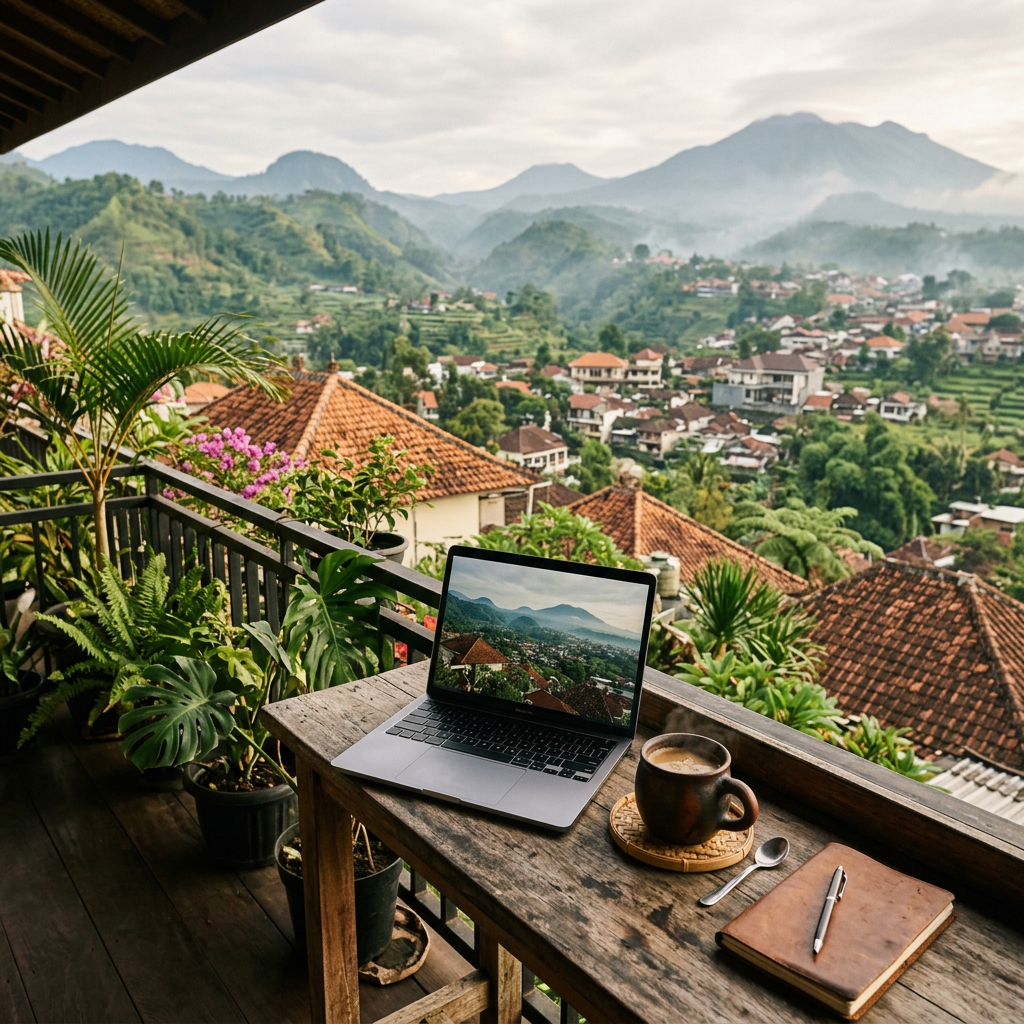
Most Malaysia guides for remote workers point to Kuala Lumpur, Penang, or Langkawi, and a Cameron Highlands digital nomad base rarely makes the list, even though it solves a problem those cities don’t: heat fatigue. Sitting roughly 1,500 meters above sea level in Pahang, this tea-growing region stays cool enough for a hoodie at night, and that alone makes it worth a look as a working base rather than only a weekend hike destination.
This guide draws on official Malaysian government sources for visa and entry rules, current property listings for rent figures, and Numbeo’s crowd-sourced pricing for everyday costs. Figures below are current as of this writing (September 2026); prices and rules change, so confirm anything time-sensitive before you book.

Why Nomads Are Looking at Cameron Highlands
Cameron Highlands is a hill station made up of a few small towns, mainly Tanah Rata and Brinchang, surrounded by tea plantations, strawberry farms, and a network of marked hiking trails. Daytime temperatures typically sit in the high teens to low twenties Celsius, a sharp contrast to the humid 30s of Kuala Lumpur or coastal Malaysia. For nomads who find tropical heat draining for focused work, that difference is the entire pitch.
It also sits inside Malaysia’s broader digital economy push. The Malaysia Digital Economy Corporation (MDEC) runs the DE Rantau Nomad Pass program, which, per MDEC’s own FAQ, covers Peninsular Malaysia and Labuan, including Pahang, where Cameron Highlands sits. For eligible DE Rantau holders, the pass provides the immigration framework to live here while carrying out qualifying remote work for foreign employers or clients.
Real Costs for a Cameron Highlands Digital Nomad Budget (2026)
Long-term rentals are the hardest number to pin down here, because most listings target tourists rather than monthly tenants. Listings checked on the property site Mudah.my included rooms and small apartments starting around RM1,200 a month, with modern full apartments listed higher depending on size and view. Short-stay homestays, by contrast, are priced nightly and run roughly RM200 to RM350 a night in regular season, climbing to RM350 to RM450 during peak holiday weeks.
Day-to-day costs are drawn from Numbeo’s Cameron Highlands dataset, last community-updated March 2025 and based on a small sample, so treat it as a rough guide rather than gospel; it’s the latest available data for this specific location as of this writing. An inexpensive local meal runs about RM14, a mid-range dinner for two around RM62, and a cappuccino about RM11. Basic monthly utilities for a small apartment average around RM205, and home broadband (60 Mbps or higher) averages around RM128 — confirm current figures directly on Numbeo’s Cameron Highlands page, since these are community-submitted and can shift.
| Expense | Typical Cost (RM) | Source |
|---|---|---|
| Room/apartment, monthly rent | RM1,200+ | Mudah.my listings |
| Homestay, nightly (regular season) | RM200-350 | Local homestay listings |
| Inexpensive local meal | RM14 | Numbeo (Mar 2025 data) |
| Utilities, small apartment | RM205/month | Numbeo (Mar 2025 data) |
| Home broadband (60 Mbps+) | RM128/month | Numbeo (Mar 2025 data) |
Altogether, a frugal solo nomad can target roughly RM3,000 to RM4,500 (about $650-$970) a month for rent, food, and basic utilities, before coworking fees and regional travel. That undercuts Kuala Lumpur city-center living, though it isn’t as cheap as flatter, less touristy parts of Malaysia like Ipoh.
Wifi and Coworking: The Reality Check
This is where Cameron Highlands asks for a trade-off. It’s hilly, rural, and built around tourism infrastructure rather than tech infrastructure, so connectivity varies block by block far more than in a planned city hub. Some accommodation providers, including Silvan Garden in Tanah Rata, market fast Wi-Fi and work-friendly rooms, which tells you reliable connectivity is a selling point here precisely because it isn’t guaranteed everywhere else — that’s a marketing claim from the property, not an independent measurement, so verify it yourself before booking.
Malaysia’s national 5G median download speed has declined from its late-2023 peak, according to Ookla Speedtest data reported by Malay Mail: 242.92 Mbps in Q3 2025, down from around 452 Mbps in late 2023, though still ahead of the Philippines, Thailand, and Japan and behind South Korea and Singapore.
However, that’s a national median, not a Cameron Highlands figure, and it doesn’t tell you what you’ll get at a specific property in the highlands. Mountainous terrain and local infrastructure can create uneven mobile coverage in specific spots, while fixed broadband quality depends more on the property, its wiring, and its provider than on elevation. Before committing to a month here, message your specific accommodation and ask for a live speed test, not a marketing claim.
Malaysia Visa and Entry Rules
Entry rules apply nationally, not just to Cameron Highlands, and they come from Malaysia’s Immigration Department (Jabatan Imigresen Malaysia). Many passport holders from Europe, North America, and other Western countries can enter Malaysia visa-free for short social visits, with the permitted stay and conditions depending on nationality, per the official visa requirement list. Rules vary by nationality, so check your specific passport against the official list rather than assuming a blanket 90-day allowance applies to you.
Since 2024, most foreign visitors must also submit the Malaysia Digital Arrival Card (MDAC) online within three days before arrival, filed directly through the Immigration Department’s own portal (third-party sites may charge unnecessary fees, so avoid those). Exemptions apply to groups including Singapore citizens, Malaysian permanent residents, and Malaysian long-term pass holders, so check the official list if you fall into one of those categories. A tourist entry is not the immigration route designed for remote work, which is why Malaysia created the DE Rantau Nomad Pass for nomads who want to stay longer and work openly.
For DE Rantau specifically, MDEC’s published criteria set a minimum annual income of $24,000 for tech/digital-field applicants and $60,000 for applicants in other eligible professions, plus proof of remote work for a non-Malaysian employer or client base. One regional catch worth knowing: the pass covers Peninsular Malaysia and Labuan only, per MDEC’s FAQ, so it applies fine to Cameron Highlands but wouldn’t cover a side trip to Sabah or Sarawak, which run separate immigration control and, in Sarawak’s case, their own DE Rantau Sarawak Pass.
Getting There and Getting Around
There’s no airport in Cameron Highlands. Most nomads fly into Kuala Lumpur, then travel time to Tanah Rata is typically several hours by road, depending on traffic, the operator, and whether you start from the city or from KLIA. Ipoh, roughly 1.5 to 2 hours away by road, is the nearer regional hub and a common stopover.
Once you’re there, the towns of Tanah Rata and Brinchang are walkable, but the wider highlands area, including the tea estates and trailheads, generally requires a car, taxi, or local shared van services. Grab, Malaysia’s dominant ride-hailing app, may be less readily available here than in KL, so don’t assume you can always summon a ride on demand.
Who Should Skip Cameron Highlands
For a would-be Cameron Highlands digital nomad whose work depends on rock-solid, low-latency video calls every day, the connectivity variance here is a real risk, not just a minor inconvenience. Nightlife and social scene are also thin compared to Chiang Mai or Bali; this is a nature-and-quiet destination first. On the other hand, if you’re chasing a change of climate and don’t mind planning around occasional patchy signal, it’s one of the more distinctive bases in Southeast Asia.

FAQ
Do I need a special visa to work remotely from Cameron Highlands?
A standard tourist entry isn’t the immigration route designed for remote employment with a foreign company, even though enforcement against quiet laptop work is rare in practice. Nomads who want a legally clean setup typically apply for the DE Rantau Nomad Pass through MDEC, which covers Cameron Highlands since it’s in Peninsular Malaysia.
Is the wifi in Cameron Highlands good enough for video calls?
It depends heavily on the specific property, since hilly terrain and local infrastructure create uneven coverage across the region. Some accommodations built for remote workers advertise fast, stable connections, but you should request a live speed test from your host before booking rather than relying on generic marketing claims.
How much does a month in Cameron Highlands actually cost?
A frugal solo nomad renting a basic room or small apartment and eating mostly local food can budget roughly RM3,000 to RM4,500 (about $650-$970) a month for rent, food, and utilities. Add coworking fees, travel, and any splurges on Western food or imported goods, and the realistic total climbs higher.
Related Reads
- Ipoh Cost of Living for Digital Nomads in 2026: Cheaper Than KL – the nearest regional hub to Cameron Highlands, useful for a cost comparison in the same part of Malaysia.
- Langkawi for Digital Nomads: Is It Worth It in 2026? – a very different Malaysian base (island, duty-free, beach) for contrast against a hill-station option.
- Kuching Digital Nomad Guide 2026: New Sarawak Pass & Cost – for nomads weighing Cameron Highlands against Malaysia’s dedicated DE Rantau Sarawak hub.
Sources
- Malaysian Immigration Department (Jabatan Imigresen Malaysia) – Visa Requirement by Country
- Malaysian Immigration Department – Malaysia Digital Arrival Card (MDAC) announcement
- Malaysia Digital Economy Corporation (MDEC) – DE Rantau Nomad Pass official page
- Numbeo – Cost of Living in Cameron Highlands (community data, last updated March 2025)
- Malay Mail – Ookla Speedtest Malaysia 5G data report on Q3 2025 figures
- Mudah.my – Cameron Highlands property rental listings, accessed September 2026