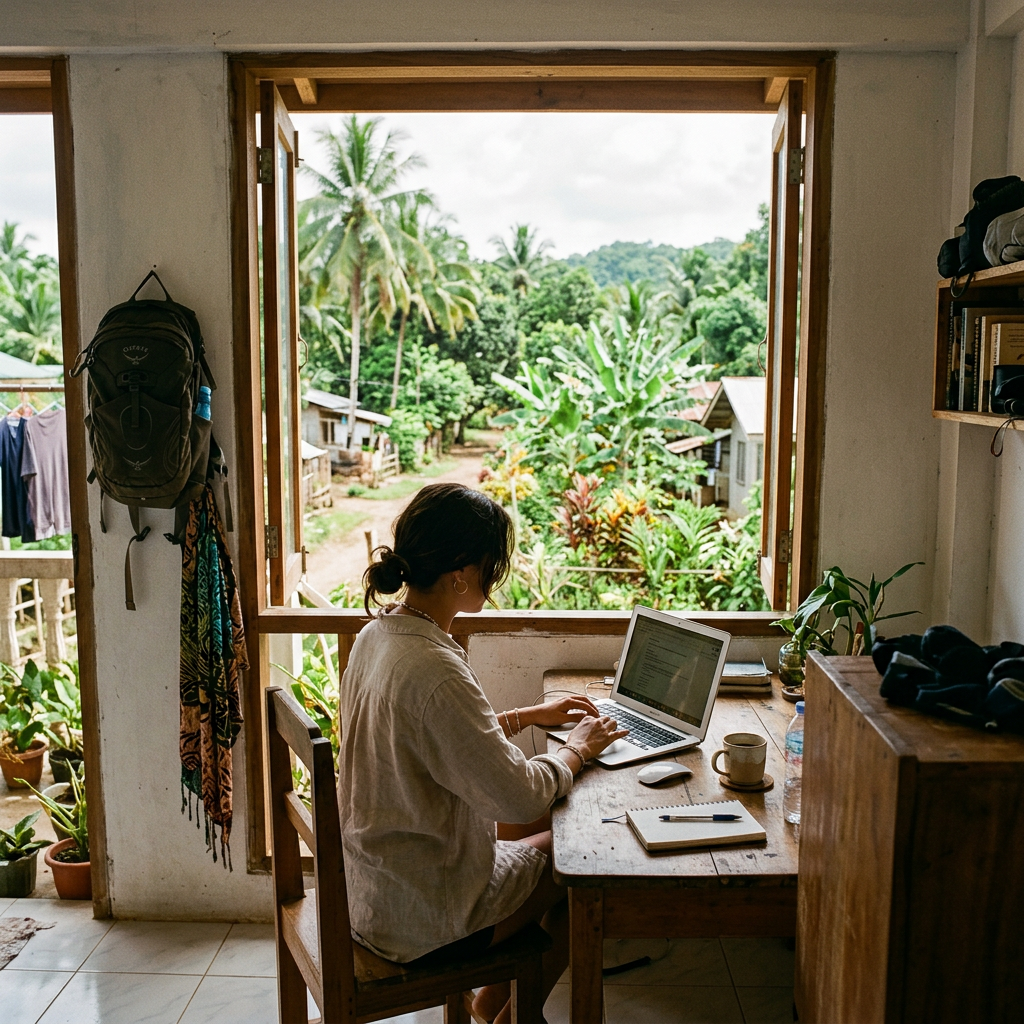
Siargao keeps showing up on “next Bali” lists. Most of those posts skip the part that actually matters for a Siargao digital nomad. The internet here isn’t what it looks like in General Luna’s cafe photos.
This guide covers what a working month here actually costs. It also covers why the wifi situation is more nuanced than “good” or “bad.” And it covers what the Bureau of Immigration requires before you set up a laptop on that rice-field balcony.
The cost figures below come from nomad-tracked cost-of-living data current as of this writing. The internet section draws on Philippine ISP performance data and firsthand coworking reviews. The visa section links directly to the Bureau of Immigration’s own pages.
As of August 2026, that’s the most current public information available. Always double-check fees on the official BI site before you travel, since schedules shift without much notice.

What a Siargao Digital Nomad Actually Pays in 2026
For a Siargao digital nomad budgeting ahead, cost trackers currently diverge quite a bit. Nomads.com puts a single person’s all-in monthly cost (including rent) around $1,255, while CityCost.org puts a moderate lifestyle closer to $778 including rent. Without rent, figures cluster more tightly in the $490-$590 range.
Average rent for a single nomad runs around $563 a month, per Nomads.com’s current data. That figure swings hard depending on whether you want a fan room near Cloud 9 or an aircon studio with a pool.
Food is where Siargao stops being cheap. General Luna’s restaurant scene caters heavily to tourists, so a smoothie bowl and flat white at a tourist-facing cafe can easily run $8-10, and that adds up fast if you eat out daily.
Cooking at home or sticking to local carinderias brings your food budget down close to Cebu or Dumaguete prices.
Internet: Why “Fast Wifi” Here Means Something Specific
Here’s an award worth knowing about, and a claim worth being skeptical of. Converge, the Philippines’ top-rated fixed broadband provider, was named “Best Internet,” “Fastest Internet,” and “Best Fixed Latency” for the first half of 2026 by Ookla, posting a Speedtest Connectivity Score of 73.14 and a Speed Score of 61.86. Those are relative index scores, not a plain download-speed number, and Converge’s own press release doesn’t publish a single national Mbps average.
That’s a nationwide figure, though, drawn mostly from cities with mature fiber buildouts. It tells you almost nothing about a rural island like Siargao.
On the island itself, nomad reports describe fixed fiber as rare and expensive, with connections that vary a lot by location. Most working nomads rely on cafes and coworking spaces running Starlink rather than home fiber.
Coco Space, one of the island’s best-known coworking spots in General Luna, runs multiple Starlink dishes plus backup ISPs, specifically because single-connection setups aren’t reliable enough alone. The space is solar-powered with a generator backup, so it stays online through Siargao’s power outages, which multiple independent nomad-guide sources describe as frequent and often unpredictable.
Reviews of Coco Space are consistently strong, but even happy members flag the honest limits. One reviewer noted the Starlink connection struggled specifically with large video uploads, even though everyday calls and browsing were fine.
If your work involves heavy file uploads, test the connection during a short stay before committing to months there. Don’t rely on a single wifi number you read online without testing it yourself first.
Visa Rules for Remote Workers
The Philippines does technically have a Digital Nomad Visa (DNV), created by Executive Order No. 86, signed in April 2025. Eligibility is narrower than the headline suggests, though, because applicants must be nationals of a country that offers Filipinos a comparable digital nomad visa in return.
We could not locate a single consolidated government list of every reciprocal eligible nationality as of August 2026, though individual Philippine embassies and consulates abroad do publish DNV guidance for their own jurisdictions. The Department of Foreign Affairs issues the visa for up to one year, renewable once, and holders can’t take local employment or run a business in the Philippines.
The order itself doesn’t set a specific income threshold, but immigration consultancies and law firms commonly cite around $24,000 in annual foreign-sourced income as a practical benchmark. A Siargao digital nomad whose home country isn’t confirmed as reciprocal, or who doesn’t meet the practical income bar, has one realistic path left: the standard tourist entry.
Many visa-exempt nationalities are admitted under EO 408 and typically receive an initial 30-day stay, extendable through the Bureau of Immigration.
Here’s the important caveat: a tourist admission is not the same as formal work authorization. Philippine immigration law generally treats any paid work — including remote work for a foreign employer or client while physically present in the Philippines — as activity a tourist entry doesn’t cover, even though enforcement against this specific pattern has been inconsistent in practice. If you don’t qualify for the DNV, confirm with Philippine immigration or a licensed immigration consultant whether your planned remote-work activity is compatible with your intended visitor status, rather than assuming a foreign income source automatically makes it fine.
Extensions are processed through the Bureau of Immigration’s Temporary Visitor Visa Waiver page. Several visa-service guides currently cite a first extension fee around ₱3,000 (roughly $54), with later extensions priced differently.
Fees and processing rules change without much public notice. Confirm the current schedule directly through the Bureau of Immigration’s e-Services portal before you plan around any specific number.
A Siargao digital nomad who overstays faces real consequences beyond a simple flat fine — overstaying can trigger administrative fines that scale with time, unpaid extension fees, and in more serious or repeated cases, blacklisting from future entry. This applies regardless of visa type.
Health, Power, and the Small Stuff That Adds Up
Dengue is present across the Philippines, including Siargao, and it tends to spike during and after the rainy months. Mosquito repellent and covering up in the evenings is standard practice for longer stays.
Check that your travel insurance actually covers medical evacuation. Siargao’s hospital is small, and more complex cases may require transfer to a larger regional center such as Cebu.
Power outages are frequent enough on the island that multiple independent nomad guides and Coco Space reviewers mention them directly. That’s exactly why the coworking space invested in solar power and a generator rather than relying on the grid.
If you’re working from a rented house rather than a coworking space, ask your landlord specifically about backup power. A dead outlet mid-deadline is a common frustration nomads report on the island.
The Philippine Department of Tourism has been actively promoting Siargao as a surf and lifestyle destination. That’s part of why the food and accommodation scene skews international in both quality and price, compared to less-visited Philippine islands.
That tourism investment is good news for infrastructure over time. It also means Siargao isn’t the budget option within the Philippines — Dumaguete and Iloilo City both run noticeably cheaper for similar quality of life.
Getting There and Where to Base Yourself
Sayak Airport (IAO) in Del Carmen connects to Manila and Cebu with regular domestic flights. Most Siargao digital nomad arrivals base themselves in General Luna. It’s the town closest to the Cloud 9 surf break, and to most of the island’s cafes and coworking spots.
Renting a scooter is the standard way to get around. The island’s main roads are paved but can flood during heavy rain.
PAGASA, the Philippines’ official weather agency, puts the national tropical-cyclone season at roughly June through November, with about 70 percent of typhoons forming in the July-through-October peak window. It’s worth checking PAGASA’s forecasts before booking a long stay in those months.
Siargao took a direct hit from a major typhoon in 2021 that leveled parts of the island’s infrastructure. Rebuilding has been extensive, but it’s a reminder that this is a real weather risk rather than a footnote.
Related Reads
- Siquijor for Digital Nomads: Why the Wifi Isn’t Ready Yet (2026) — another Philippine island facing the same fiber-vs-Starlink tradeoff, useful if you’re comparing Visayas options.
- Iloilo City Digital Nomads: 5 Things to Know (2026) — a city-based Philippine alternative with more reliable fixed internet than Siargao.
- Dumaguete Cost of Living for Digital Nomads in 2026 — a lower-cost, calmer Philippine base for comparison.

FAQ
Is Siargao’s internet reliable enough for full-time remote work?
For a Siargao digital nomad handling calls, browsing, and most day-to-day tasks, yes, especially from a Starlink-equipped coworking space. For work that depends on large uploads or perfectly stable video calls, plan a backup option and test the connection for a few days first.
Do I need a special visa to work remotely from Siargao?
Technically yes, a Digital Nomad Visa exists under Executive Order 86, but it’s only open to nationals of countries offering Filipinos a reciprocal visa, and no consolidated qualifying-country list has been published yet. Without the DNV, most remote workers enter on the standard tourist visa waiver, but a tourist admission is not the same as formal authorization to work — even remotely for a foreign employer. Confirm your specific situation with Philippine immigration or a licensed consultant rather than assuming a foreign income source resolves the question.
When is the best time of year to be in Siargao as a nomad?
Many nomads prefer December through May, outside PAGASA’s peak typhoon window. If you stay through the June-to-November season, keep an eye on PAGASA’s forecasts and book flexibly.
Sources
- Official Gazette of the Republic of the Philippines, Executive Order No. 86, s. 2025 (Digital Nomad Visa)
- Bureau of Immigration Philippines, Temporary Visitor (9A) Visa Waiver
- Bureau of Immigration Philippines, e-Services portal
- Converge ICT Solutions, Converge tops Ookla fixed broadband metrics for 1H 2026 (Ookla Speedtest Intelligence data)
- Coco Space Siargao, official facilities page
- Nomads.com, Cost of Living in Siargao, and CityCost.org, Siargao cost-of-living page, current as of this writing
- PAGASA (DOST), Tropical Cyclone Information